
[ad_1]
The latest:
-
The land search is finished, the authorities said on Tuesday, but the official death toll has remained at 115 for several days and may not go much higher. Maui County has publicly identified 45 people after notifying their families.
-
Hawaiian Electric, the state’s largest utility and the parent company of the power provider on Maui, acknowledged late on Sunday that its power lines had started a wildfire on Maui. However, the utility said that the fire was extinguished before a second one erupted and destroyed Lahaina. The utility said that county firefighters were at fault for declaring that the fire was contained and then leaving the scene. The cause of the wildfires has not been determined.
-
Hawaii’s attorney general, Anne E. Lopez, told property owners in the burn area to report any unsolicited offers to buy their properties. “Preying on people who suffered the most from the tragedy on Maui is despicable,” she said on Monday.
Three weeks after wildfires swept across Maui, Gov. Josh Green of Hawaii announced that 99 percent of the search of the burn area had been completed. He and other officials have acknowledged that some of the dead may never be found or identified.
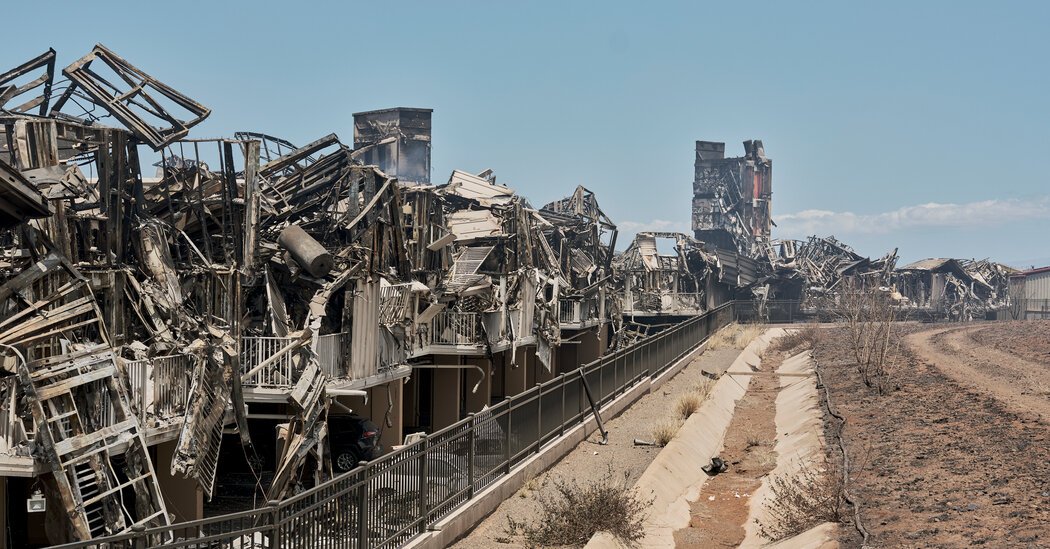
Maui’s police chief, John Pelletier, said on Tuesday that teams continued to search the remaining 1 percent of the burn area: the water 200 yards out along a four-mile stretch of coastline. No human remains have yet been found in the water off Lahaina, the centuries-old town of 13,000 that was largely destroyed by the fires.
The land search-and-rescue crews, including cadaver dogs and forensic anthropologists, combed for bone fragments through the ash in the burn area. Without fingerprints or dental records that can be used to identify human remains, officials have resorted to DNA testing. DNA samples from family members are still being sought to compare with remains that have been found.
While the F.B.I. is working to vet a list of up to 1,100 people who were initially reported missing, Maui officials released a list of 388 people on Thursday for whom officials had full names as well as contact information for the person who had reported them missing.
Officials implored anyone who knew that a person on the list was safe to contact them.
They received more than 100 responses within one day. On Tuesday, Chief Pelletier said another 100 have since responded.
“As we get someone off of a list, this has enabled us to devote more resources to those who are still on the list,” Steven Merrill, the special agent in charge of the F.B.I.’s Honolulu office, said during a news conference on Friday.
By making the names public, the authorities hoped to narrow the tally of the missing.
But it can take months or even years of forensic analysis and DNA testing to identify the dead, similar to the aftermaths of the Sept. 11 terrorist attacks, Hurricane Katrina and the wildfire that devastated Paradise, Calif.
“We may not know in the end about everybody,” Mr. Merrill said.
The death toll seems certain to keep rising.
The death toll of at least 115 marks the fires on Maui one of the worst natural disasters in Hawaii’s history and the nation’s deadliest since 1918, when blazes in northeast Minnesota killed hundreds of people.
The slow pace of identifying victims was dictated, officials said, by the large-scale destruction and by Maui’s remoteness, which complicated the arrival of out-of-state search dog teams. About 340 emergency personnel and 50 canine units participated at the peak of the search.
Displaced residents have been moved to hotels.
Emergency shelters, which housed more than 2,000 people the day after the fires broke out, have been emptied, and displaced residents are staying in hotels, in an effort coordinated by the American Red Cross. They will be housed and fed there through at least the spring, officials said.
County and federal aid efforts gathered pace over the last two weeks, after frustrated residents in West Maui initially said that they were receiving far more help from an ad hoc network of charitable organizations and volunteers than they were from the government.
As of this week, about 11,000 assistance registrations have been received by the Federal Emergency Management Agency, with $14.6 million in federal housing and individual assistance provided, officials said.
Governor Green said that 6,000 people were living in hotels and Airbnb units.
What caused the fires?
No single cause has been determined, but experts said one possibility was that active power lines that fell in high winds had ignited a wildfire that ultimately consumed Lahaina.
Brush fires were already burning on Maui on Aug. 8. Maui County officials informed residents that morning that a small brush fire in Lahaina had been completely contained, but several hours later they issued an alert that described “an afternoon flare-up” that prompted evacuations.
The fires on the islands were stoked on Aug. 9 by a combination of low humidity and strong mountain winds, brought by Hurricane Dora, a Category 4 storm hundreds of miles away.
Worsening drought conditions in recent weeks probably also contributed. Nearly 16 percent of Maui County was in a severe drought, according to the U.S. Drought Monitor.
Maui County officials claimed in a lawsuit filed on Thursday that the “intentional and malicious” mismanagement of power lines by Hawaiian Electric had allowed flames to spark. Earlier, law firms filed suits on behalf of victims, claiming that Hawaiian Electric was at fault for having power equipment that could not withstand heavy winds and for keeping power lines electrified despite warnings of high winds.
Shelee Kimura, the chief executive of Hawaiian Electric, said on Sunday that the county’s lawsuit was “factually and legally irresponsible.” In a statement, the company said that a fire caused by one of its downed electric lines was extinguished before a second blaze erupted, destroying Lahaina.
What’s next?
There are widespread fears that rebuilding will be difficult or impossible for many residents. State and local officials are considering a moratorium on sales of damaged or destroyed properties to prevent outsiders from taking advantage of the tragedy.
And the Hawaii Tourism Authority said visitors planning to travel to West Maui within the next several months should delay their trips or find another destination. Most of the 1,000 rooms in the area have been set aside for evacuees and rescue workers.
The hit to the tourism industry presents a major challenge to rebuilding the island’s economy.
A longer-term worry is the changing climate.
The area burned by wildfires in Hawaii each year has quadrupled in recent decades. Invasive grasses that leave the islands increasingly susceptible to wildfires and climate change have worsened dry and hot conditions in the state, allowing wildfires to spread more quickly, climatologists say.
Ivan Penn, Kellen Browning and Eileen Sullivan contributed reporting.
[ad_2]




Add comment